


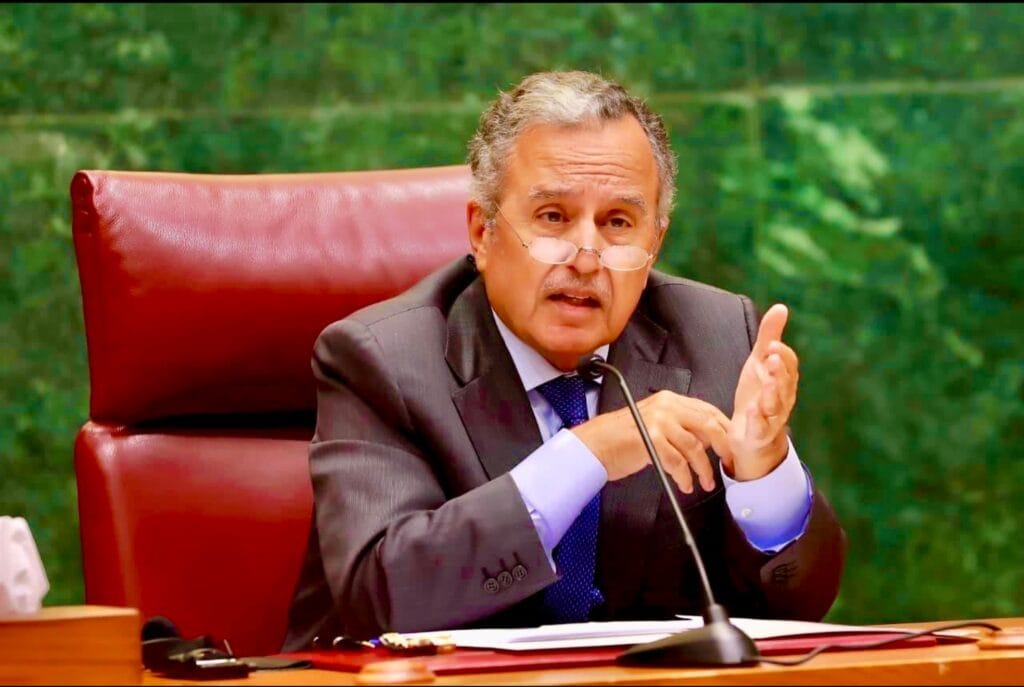
Arab League Headquarters, Cairo – By Dalia Attia
At a time when the war in Gaza intersects with mounting regional instability and the foundations of the international order are being tested as never before, Arab League Secretary-General Nabil Fahmy used his first press conference since taking office to deliver more than a statement of institutional priorities. His address offered a broader political vision for repositioning the League as a more influential actor in an increasingly volatile international environment
Speaking from the League’s headquarters in Cairo, Fahmy’s remarks extended well beyond the day-to-day management of regional affairs, Instead, they outlined a strategic approach aimed at transforming the Arab League from an institution that reacts to crises into one that helps anticipate and shape regional developments
Within this framework, Fahmy stressed that the Arab world could no longer afford to remain a bystander to rapidly evolving geopolitical shifts. Protecting Arab interests, he said, requires a more proactive diplomatic approach supported by early-warning mechanisms and preventive diplomacy capable of addressing crises before they escalate
The Palestinian issue remained at the center of that vision, Fahmy described the situation in Gaza and the occupied West Bank as “an ongoing genocide,” saying the League would continue supporting international legal efforts to hold those responsible accountable, while reaffirming its commitment to defending the legitimate rights of the Palestinian people and preserving the legal and historical status of Jerusalem
Expanding the traditional concept of national security, Fahmy linked sovereignty and regional security with food security, energy resilience, supply chains and Arab economic integration, His remarks reflected a broader understanding that influence in the twenty-first century is determined not only by military power or political alliances, but also by the ability of states to build resilient, interconnected economies
Institutional reform also featured prominently in the Secretary-General’s agenda, He outlined five strategic priorities for the coming phase, including strengthening preventive Arab diplomacy, restructuring the General Secretariat, promoting a culture of implementation and accountability, investing in human capital and technology, and aligning political decision-making with sustainable development objectives
Addressing the media, Fahmy pledged to pursue a policy based on transparency and openness, arguing that the public’s right to information is essential to rebuilding trust between institutions and society
As he concluded with a call for broader Arab partnership, the central message emerging from the conference was clear: the future relevance of the League of Arab States will depend less on its ability to issue statements than on its capacity to translate political consensus into practical action at a time when regional and global power dynamics are being fundamentally reshaped

