Cairo : By Dalia Attia
In a media landscape increasingly shaped by algorithms, artificial intelligence, and the rapid circulation of information, journalism education faces a defining question: how do we prepare media professionals who can think critically rather than merely reproduce content?
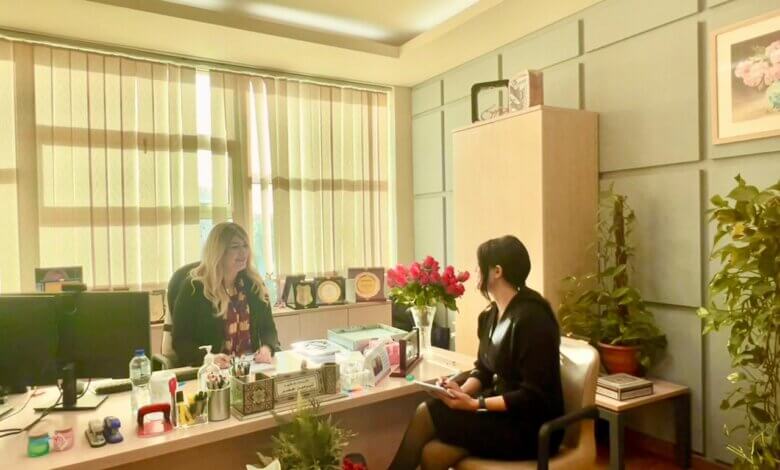
From her office at the Arab Open University in Cairo, Dr. Nermin Khadr — Professor of Media at Cairo University and Central Dean of Media Faculties across the university’s Arab branches — speaks of a profession at a crossroads, For her, the transformation is not simply technological; it is philosophical
“Journalism is no longer transitioning from paper to screen,” she explains, “We are witnessing a shift in the very philosophy of content production, Speed dominates, but credibility and depth remain the true benchmarks”
Bridging Academia and the Market
Since joining the Arab Open University in 2018 as Local Dean in Egypt — and later assuming the role of Central Dean across multiple Arab branches — Khadr has placed curriculum reform and market alignment at the center of her agenda
“It is no longer acceptable for curricula to remain static while the industry evolves daily,” she says, “Students must graduate having practiced journalism, not merely studied it”
For Khadr, training is not supplementary; it is foundational, Without practical exposure, she argues, graduates risk entering a highly competitive field armed with theory but lacking professional readiness
Artificial Intelligence: Tool, Not Author
As artificial intelligence increasingly penetrates newsrooms and research environments alike, fears about professional displacement persist, Khadr adopts a measured view
“AI can assist with gathering information and drafting preliminary texts,” she notes, “but it cannot replace human judgment, contextual understanding, or creative intuition”
Universities, she adds, must establish clear ethical frameworks governing its use, particularly in graduate research, “Technology should enhance analytical capacity — not substitute it”
Safeguarding Credibility in an Era of Information Warfare
In a regional and global context marked by disinformation and strategic narratives, Khadr underscores the responsibility of media professionals to navigate carefully between speed and accuracy
“Returning to official sources is essential, but it is not sufficient,” she says, “Journalists must diversify references, follow international coverage, and compare narratives before publishing, Objectivity is built through comparative reading and accumulated experience”
For students, mastering a second language and understanding how international media frame their country is, in her view, indispensable
Leadership Beyond Borders
Over a career that began at Cairo University in the mid-1990s and evolved through research on international media representations of the Middle East, Khadr’s perspective has broadened from academic inquiry to institutional leadership
Today, overseeing media faculties across several Arab countries, she speaks of harmonizing academic standards while respecting local contexts — a balance she considers vital for building competitive Arab media professionals
A Profession Rooted in Responsibility
As our conversation drew to a close, I asked her — not only as a journalist concluding an interview, but as a media professional still learning — what advice she would offer me as I continue navigating this evolving field
“Do not approach media as a pursuit of fame,” she told me, “Approach it as a responsibility toward society, Continue learning, preserve your ethical compass, and never lose your human voice”
In a time of accelerating technology and shifting narratives, Khadr’s vision reflects an Egyptian academic leadership that seeks to anchor Arab media education in rigor, ethics, and adaptability — preparing a new generation not merely to operate within the system, but to shape it